



The science behind Lumenate
Harnessing the power of flickering light
Neural Entrainment
Your brain has a natural tendency to fall into rhythm with the world around it: its electrical activity, or brainwaves, can begin to resonate with external rhythms like light and sound. This phenomenon is called neural entrainment, and research shows that Flicker Light Stimulation (FLS) can generate it. Lumenate uses the principles of FLS to gently guide you into a state of consciousness between deep meditation and a psychedelic-like experience.
A semi-psychedelic state
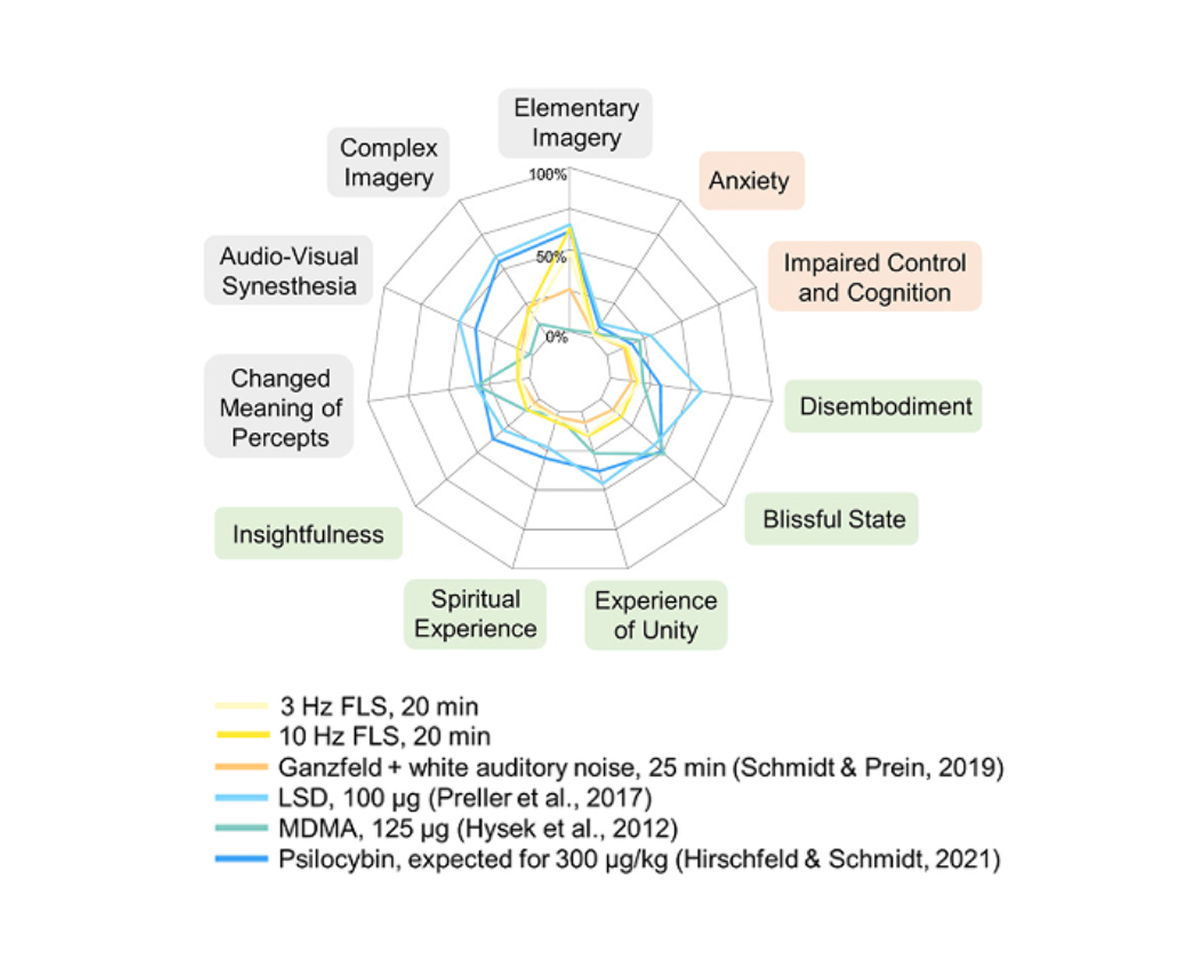
Although everyone’s experience is unique, many people describe feeling completely immersed in a kaleidoscopic experience created by their own mind. A peer-reviewed research study has even demonstrated that “flicker light stimulation is capable of inducing visual effects with an intensity rated to be similar in strength to effects induced by psychedelic substances” (Bartossek et al., 2021).
A chart from this paper compares experiences under Flicker Light Stimulation (FLS) with those under psychedelic substances. The effects aren’t equivalent, but the quality of the experience shares similarities.
Additionally, expect to feel completely absorbed in the present moment with racing thoughts calmed. This immersion in the moment not only quiets aspects of your mind and thoughts, but also elevates others, with one peer-reviewed study showing that the flicker-induced state of consciousness significantly enhances emotional response to music, with approximately half the effect size of LSD (Montgomery et al., 2024).
When combined with Lumenate’s world-class content library, expect deeply moving and impactful journeys across a huge variety of topics and emotions.
Finally, and perhaps just as important as its benefits, the Lumenate experience is also hugely enjoyable. Caring for your wellbeing doesn’t have to be a chore.
Research highlights
Some of our favourite findings from studies into flicker-induced states from our friends and collaborators at a range of leading universities:
- Increased emotional response to music
- Increased signal diversity
- Psychedelic-like visual experience
- Thalamocortical Hyperconnectivity
It has been shown that in a flicker-induced state of consciousness, your emotional response to music is significantly enhanced, with roughly half the effect size of LSD. Also in keeping with comparable results using LSD, the increase is most significant in emotions of ‘Transcendence’, ‘Wonder’ and ‘Joyful Activation’.
One of the most important measures of states of consciousness is Signal diversity. In the early 2000’s this was applied in the context of anaesthetics, where decreases in it were used to measure the depth of general anaesthesia, or how ‘unconscious’ someone was. In 2016 however, Imperial College applied this same measure to psychedelic states and found it significantly increased, sparking labels of a ‘higher state of consciousness’. In one study, the same measure was seen to increase in the flicker-induced state. Flicker light stimulation has also recently been listed among the brain’s ‘expansive states‘ of consciousness.
Research shows that flicker light is capable of inducing simple visual hallucinations with an intensity rated to be similar in strength to effects induced by psychedelic substances.
An fMRI study showing some interesting similarities between the neural mechanism behind both hallucinations caused by flicker, and those caused by psychedelics.
Working together to
advance the field
Lumenate supports universities around the world to deepen research and further human understanding. If you work with an institution interested in exploring altered states of consciousness, we’d love to hear from you – you can reach us at [email protected]